
Are Poa Annua and Chick Weed Killing Your Lawn?
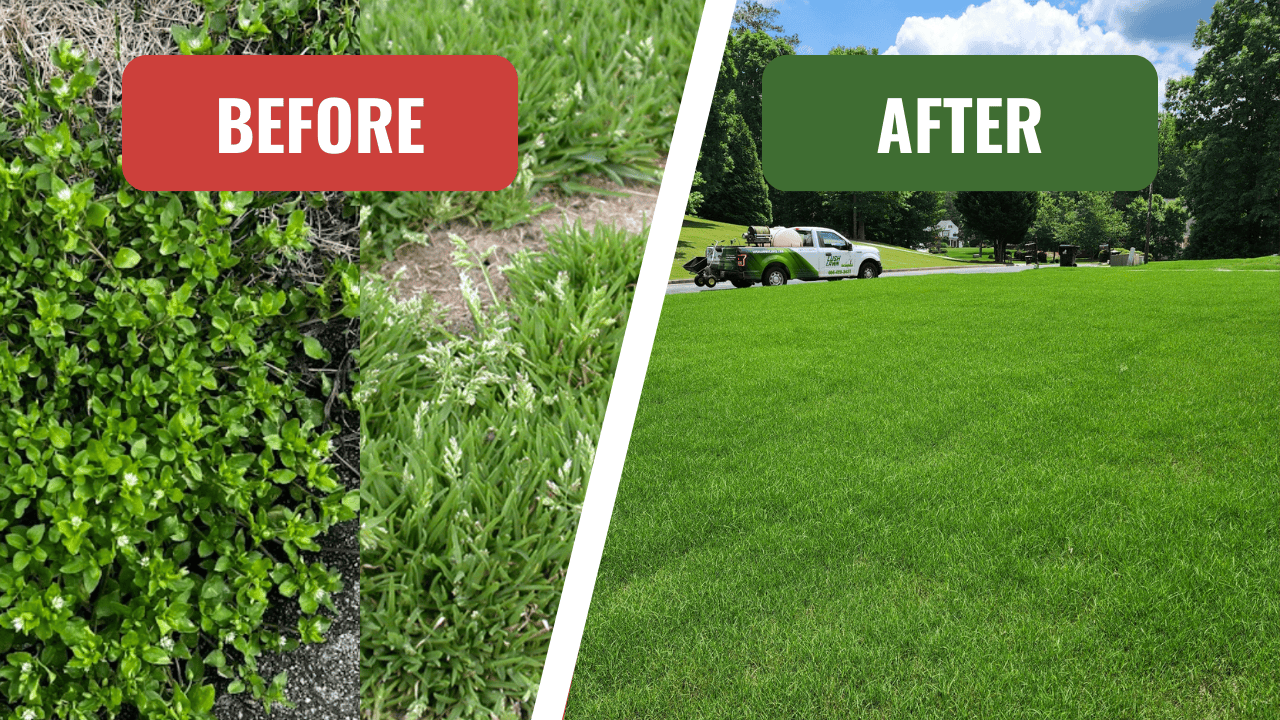
When James in Tyrone, GA called us, he was frustrated.
His Bermuda lawn had been slowly taken over by Poa annua and chickweed. What started as “a little winter green” had turned into a full backyard invasion. Thin turf, patchy color and uneven growth. He told us, “I fertilized it myself, but it just looks worse every month.”
By the time we walked his beautiful home in nearly 60% of the lawn surface was covered in cool-season weeds. The Bermuda underneath was weak and struggling to compete.
This wasn’t a mowing issue, it was a weed control and fertilization problem.
The Plan: Precision, Not Guesswork
We explained that true Weed Control and fertilization requires timing, chemistry, and discipline. Throwing fertilizer on top of weeds only feeds the problem.
Here’s how we approached it:
Phase 1 – Immediate Stabilization (Weeks 1–2)
-
Targeted post-emergent applications for active Poa annua and chickweed
-
Specialized spot treatments in dense clusters
-
Careful calibration to protect dormant Bermuda
-
No blanket fertilization during heavy weed pressure
We focused on reducing competition first.
Phase 2 – Strategic Recovery (Weeks 3–6)
-
Follow-up spot treatments where needed
-
Introduction of pre-emergent barrier to prevent future germination
-
Measured nutrient application to strengthen Bermuda without overstimulating weeds
This is where most DIY programs fail. Timing between pre and post-emergent matters. Application rates matter and soil temperature matter also.
Phase 3 – Turf Thickening & Color Restoration (Weeks 6–10)
-
Balanced fertilization designed for Bermuda growth
-
Monitoring thin areas previously shaded by Poa
-
Reinforcement Weed Control and fertilization adjustments
By week 8, visible green density increased. By week 10, the Poa was collapsing and the Bermuda was pushing back aggressively.
The Results
Three months after starting:
-
85% reduction in Poa annua
-
Chickweed eliminated in high-pressure zones
-
Noticeably thicker Bermuda coverage
-
Evening color across front and back yard
-
No turf burn, over-stimulation, or patchy regrowth
James told us, “It finally looks like a lawn again.” That’s what happens when weed control and fertilization are done strategically, not reactively.
Why This Matters in Tyrone
In Tyrone, GA, Poa annua weed is common because of fluctuating winter soil temperatures. Without proper fall pre-emergent and disciplined winter spot treatment, it will return year after year.
The difference between a lawn that survives and one that thrives is simple: Proactive Weed Control and fertilization.
Want a Lawn Like This?
If Poa annua or chickweed are creeping into your yard in Tyrone, GA or the surrounding areas (like Fayetteville) now is the time to act.
Let’s build a plan for your lawn and weed challenges. Your lawn doesn’t have to lose another season.
Call or text 404-423-3431
Visit lushlawnscapes.com to request your free evaluation
Budget: $40 - $70
Location: Tyrone, GA
Project Image Gallery
Products Used
-
Pre/Post Emergent, Specialized Spot Treatments